Stinging insect activity peaks rapidly across Orange County due to elevated summer humidity, daily rain showers, and uninterrupted foraging seasons. In communities like Baldwin Park and Delaney Park, paper wasps…
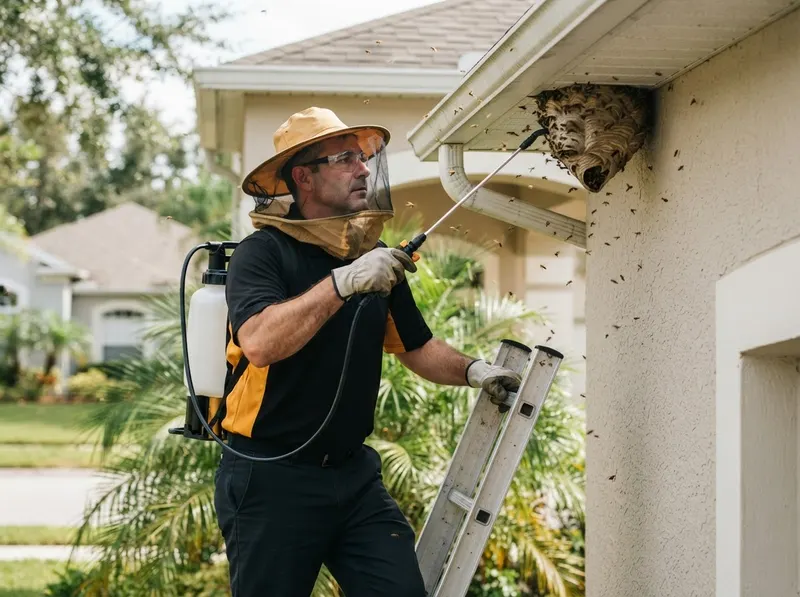
Stinging insect activity peaks rapidly across Orange County due to elevated summer humidity, daily rain showers, and uninterrupted foraging seasons. In communities like Baldwin Park and Delaney Park, paper wasps frequently establish open-comb nests under architectural soffits, high porch ceilings, and door overhangs. Yellowjackets frequently exploit sandy soil voids near garden beds or infiltrate structural weep holes in Doctor Phillips and Lake Nona brick veneer homes. A subterranean or wall-void yellowjacket colony can host 1,000 to 4,000 workers by late summer, creating an immediate physical hazard near entryways, walkways, and backyard patios. Attempting water-hose destruction or retail aerosol sprays often disperses alarmed insects throughout building vents, increasing sting incidents.
Decision fit hinges on nest architecture and colony maturity. An exposed paper wasp nest hanging from a first-story fascia in College Park requires focused pyrethroid contact aerosols followed by scraper removal, a sequence taking under 45 minutes. Conversely, a bald-faced hornet carton nestled 20 feet up inside an oak canopy near Lake Eola Heights, or a concealed yellowjacket nest inside a dry-wall void in Conway, demands pressurized micro-encapsulated dusts and specialized respiratory extraction gear. The operational trade-off centers on non-destructive exterior entry versus selective drywall incision: localized dust injection eliminates the internal brood without wall demolition, though interior comb decay requires structural sealing within 72 hours to prevent secondary beetle infestations.
Treatments withstand typical afternoon Central Florida downpours. Licensed applicators place water-insoluble residual formulations under sheltered eaves, roofline returns, and subterranean voids where storm runoff cannot wash the barrier away. Every deployment follows a structured sequence: 1. Perimeter inspection and species identification to determine venom profile and nest boundaries. 2. Direct injection of fast-acting knockdowns into primary entrance holes. 3. Physical extraction of the paper comb or fibrous aerial envelope. 4. Application of a residual perimeter barrier to stop returning field foragers from rebuilding.
Every job gets a firm, written price after a free on-site visit.
Tell us about your emergency wasp, hornet, and yellowjacket removal job in Orlando and we'll send a clear, written quote, usually the same day.
 Yellow Jacket Pest Control